

The AI-powered, WhatsApp-first platform building the trust layer for long-distance travel across Africa
Crab a Ride lets people search for, book, pay for and coordinate long-distance carpooling rides through WhatsApp.
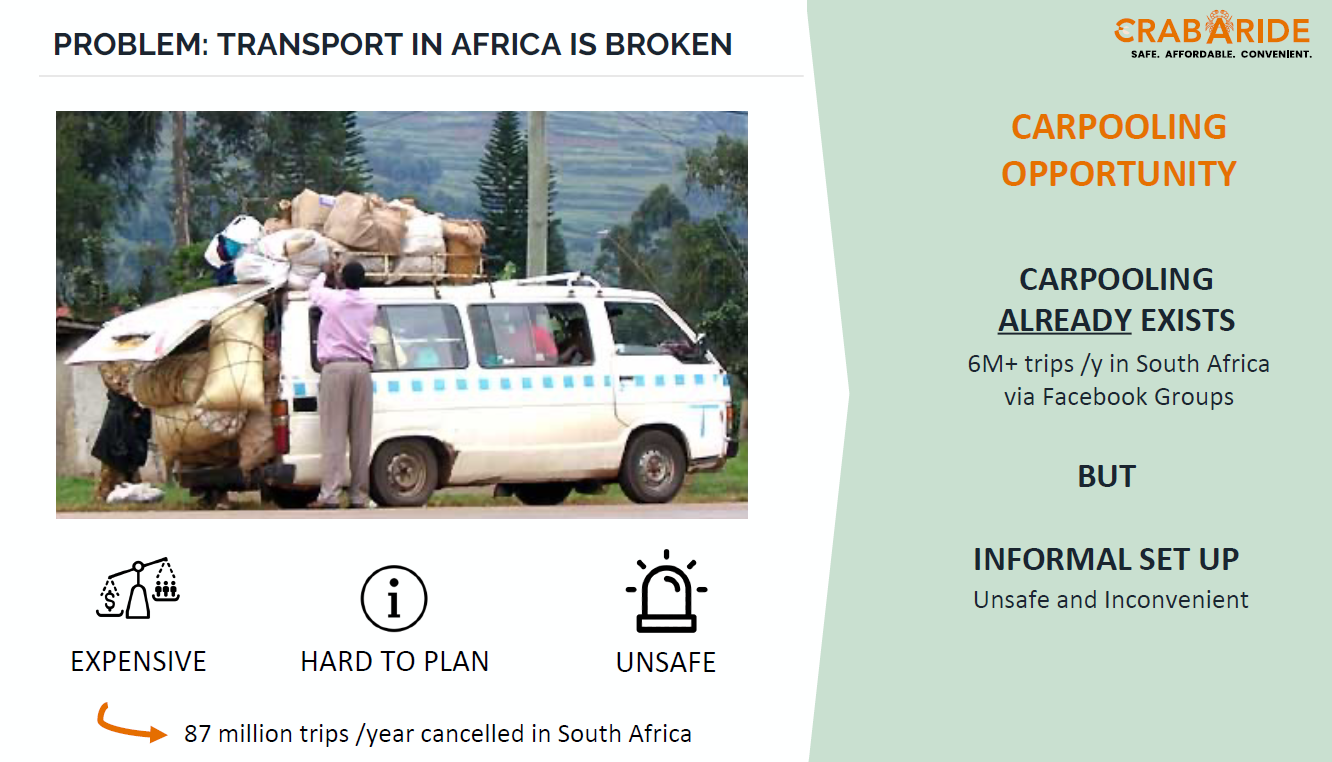
The opportunity: the market already exists. Over 6 million people transact over USD 100 million annually through facebook groups in South Africa. Demand exists. Supply exists. What is missing is the infrastructure to make these transactions safe, structured and scalable.
Crab a Ride is building it.
A large market hiding in plain sight
Long-distance travel in Africa is expensive, hard to plan and unsafe.
Formal buses and informal minibuses are unreliable, inconveniently located, disconnected from the passenger’s final destination and unsafe. As a result, a disproportionate amount of people prefer cancelling their trips altogether (87 million long-distance trips are cancelled every year in South Africa alone).
People turn to carpooling because it solves part of the problem: affordable, flexible and door-to-door. Yet, it remains undermined by its informal set up: Facebook groups and WhatsApp conversations lack identity verification, structured booking, transparent pricing and user accountability.
Crab a Ride’s core insight is simple: the market does not need to be created. It needs to be formalised.
A team that experienced the problem first-hand
Theodore, Tawanda and Tanaka have more than 20 years of combined experience across 14 African countries, where they have lived, worked and travelled. They experienced the limitations of long-distance transport first-hand and saw how travellers were already solving the problem through informal communities. Together, they bring the three capabilities required to build Crab a Ride: finance and strategy, AI engineering, and community-led execution.
CEO Theodore Chartier-Rueg has worked in leveraged finance, energy and mobility across Europe, Uganda, Tanzania and South Africa. He studied at HSG, Stellenbosch University and London Business School.
CTO Tawanda, a University of Cape Town graduate who grew up in Zimbabwe and South Africa, built one of South Africa’s first AI agents for a leading ecommerce platform before starting Crab a Ride.
CMO Tanaka is a Zimbabwean software engineer and founder of the Heartwave Foundation, where she mobilised a community of 20,000 women to fight period poverty.
Non Disruptive Approach
Crab a Ride is built around existing habits, making use of the tools users already know and trust. WhatsApp provides a familiar (94% adoption rate in South Africa), low-data interface that works on inexpensive phones making it the natural interface through which to deliver the service. Combined with AI, it makes finding and booking a ride incredibly simple.
Users can search through the website or send Crab a Ride a text or voice note directly on WhatsApp. They can then book, pay for and coordinate their pickup through the same conversation.
Behind the interface, Crab a Ride’s AI agent interprets ride requests, optimises routes, matches riders and drivers, and automates outreach. Identity verification, vehicle checks and user ratings make participants traceable and accountable.
No additional app. No password. No unfamiliar workflow. Crab a Ride preserves the convenience of informal carpooling while adding the safety and structure it currently lacks.
Early traction confirms demand
Since launching in 2024, Crab a Ride has recorded:
53,000+ rides uploaded
6,500+ verified users
Monetisation validated through niche transport partnerships, generating an average of US$2,000 in revenue per event
A planned Q4 2026 car-rental pilot with a US$2 billion African scale-up
These early transactions have also revealed an important trust dynamic. First-time users often prefer cash because scams are widespread. Once Crab a Ride has established trust, repeat users become more willing to pay by card. Its niche-market partnerships validated both this behaviour and users’ willingness to transact through the platform.
The current constraint is not demand. It is route-level liquidity and capital. Crab a Ride needs more drivers on each corridor to satisfy existing ride requests. At its current budget, the company limits its AI matching and outreach to approximately 100 viable trips per day. This is a spending constraint, not a shortage of market activity.
Capital-efficient distribution
Most early marketplaces must spend heavily to create both supply and demand. Crab a Ride starts inside communities where riders and drivers already meet.
The company has acquired and operates Facebook carpooling communities representing 520,000 members. Its AI identifies potential matches within those communities, converts participants into verified users, and moves informal conversations into bookable and monetisable transactions.
The early acquisition economics are unusually strong:
US$0.17 per new user through AI matching and outreach
Below US$0.10 per new user through Facebook-community conversion
300% user growth in one month through a radio partnership in Alexandra Township
Crab a Ride is not paying to manufacture liquidity. It is paying to convert existing liquidity into trusted transactions.
A simple, scalable business model
Crab a Ride charges a 10% commission on completed trips, deducting the amount from the drivers’ payout. Passengers can pay using cash, card or mobile money. This allows the platform to accommodate existing payment habits while progressively moving repeat users towards digital transactions as trust in the brand grows.
South African Facebook carpooling is the company’s initial beachhead. From there, Crab a Ride is targeting a US$5.5 billion serviceable obtainable market across long-distance road transport, including empty private-car seats, buses and informal transport.
As Crab a Ride enters new markets, the same AI-powered WhatsApp layer can coordinate multiple forms of long-distance transport —carpooling, buses and informal operators—through a single conversation and adapt to each users’ unique circumstances. Users will not need to identify the right operator, platform or application themselves; they will simply state where they need to go, Crab a Ride AI will do the rest.
Expansion follows existing travel behaviour: first across South Africa, then along cross-border routes and into other African markets.
Facebook communities are the initial distribution wedge. WhatsApp is the scalable transport interface. As the network grows, defensibility compounds through community distribution, verified users and vehicles, local trust, and proprietary matching and transaction data.
Raising US$400,000 to reach critical mass
Crab a Ride is raising US$400,000 at a US$4 million valuation.
The company has already secured:
US$100,000 committed by a European corporate venture investor
A US$200,000 letter of intent from a US-based investor
It is now seeking a lead investor to complete the round.
The capital will be used to deepen the WhatsApp and AI product, scale matching and outreach, acquire additional online communities, and build the route-level liquidity required for reliable matching.
The target milestone is 560 bookings per day within 6 months of funding to reach operating break-even. Within 12 months, they aim to capture 50% of the existing Facebook market.
Turning existing behaviour into infrastructure
Crab a Ride is not trying to persuade Africans to carpool. It is making long-distance transport safer and simpler.
Its starting point is an existing US$100 million informal market, which it is turning into a verified, bookable and monetisable transport network through a product built around local behaviour and an acquisition model designed to scale capital-efficiently.
From there, Crab a Ride’s ambition is broader: to make long-distance transport options across Africa accessible through a single WhatsApp conversation.
Crab a Ride at a glance
Product
AI-powered, WhatsApp-first platform for long-distance transport, beginning with carpooling.
Immediate opportunity
More than 6M annual carpooling trips, worth over US$100M, already coordinated through South African Facebook groups.
Traction
53K+ rides shared, 6.5K+ verified users and an average of US$2K in revenue per partner event.
Distribution
Facebook carpooling communities representing 520K members.
Customer acquisition
US$0.17 per new user through AI matching and below US$0.10 through Facebook-community conversion.
Business model
10% commission on completed trips.
Expansion market
US$5.5B serviceable obtainable market across long-distance road transport.
Fundraising
US$400K at a US$4M valuation, with US$100K committed and a US$200K investor LOI.
Funding milestone
560 bookings per day and operating break-even.