

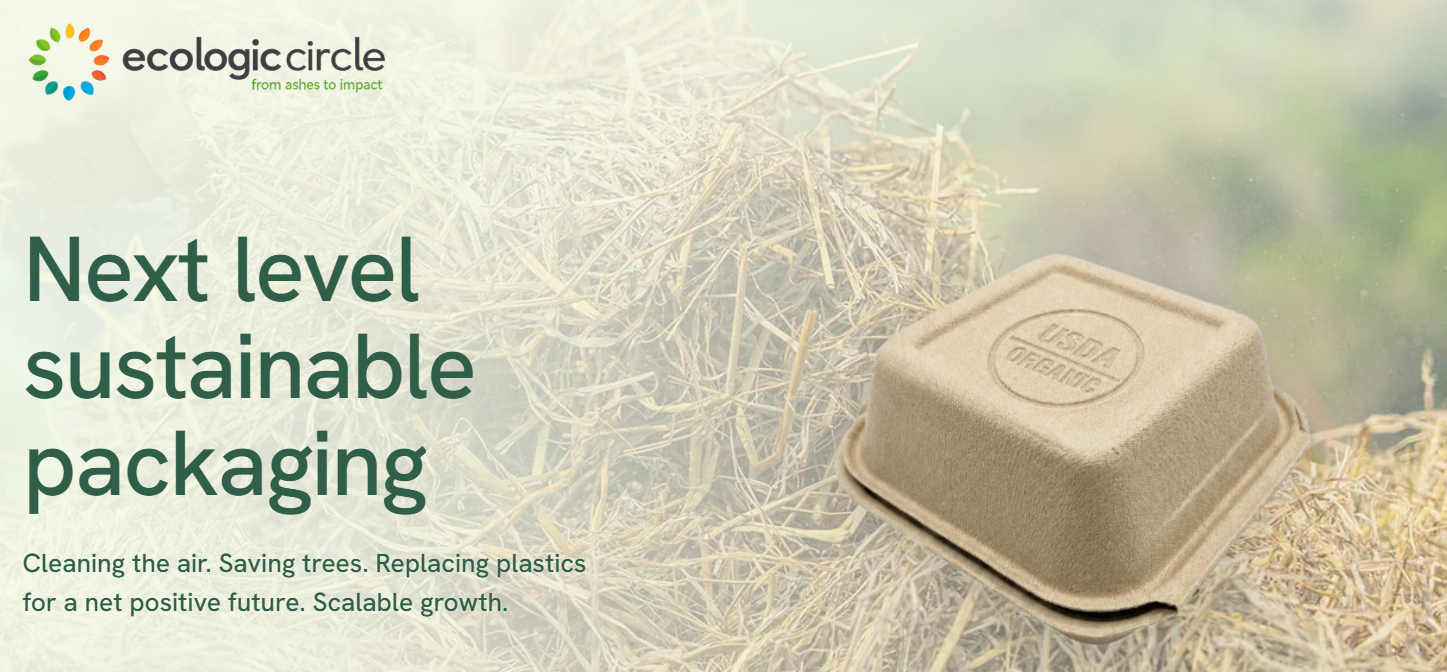
A Thai startup making certified-organic food packaging from rice straw.
Deal Snapshot
| Category | Details |
|---|---|
| Company | Ecologic Circle |
| Location | Thailand (pilot at the co-founder's rice mill) |
| Sector | Sustainable food packaging made from rice straw |
| Stage | Pilot: pulping line operational (3–4 tonnes of straw a day) |
| Fundraising | Raising USD 500K for the molding line equipment and working capital to run it |
| Core Edge | Certified traceable organic packaging, the first in the world as far as the founders know. Rice straw residue is typically burnt by farmers, while bagasse comes from sugar factories. |
| Target Markets | Organic food brands and compostable food packaging distributors in Europe and the US; Thai takeaway market |
The Problem: Straw That Goes Up in Smoke
After every harvest, rice straw across Southeast Asia is burned in the field. The smoke makes people sick, and some die from the pollution.
The less visible damage is to the soil. Burning kills the microbes and the natural systems that keep soil alive, leaving ground that does little more than hold the plant up. Farmers make up for it with chemicals: Thailand imports more than 6 million tonnes of chemical fertilizer a year.
The Idea: Make Straw Worth More Than a Match
Ecologic Circle buys straw from farmers, pulps it with a low-effluent process, and molds it into compostable food packaging, such as the trays used for strawberries, blueberries and mushrooms, to replace plastic.
The pulping byproduct, which would pollute waterways if discharged, becomes organic fertilizer for organic farmers at a lower cost than chemical fertilizer. Rice husk from the mill can be turned into biochar, which cuts energy costs (a big part of the cost of pulping and molding) and generates carbon credits.
One raw material, several revenue streams: pulp, molded packaging, organic fertilizer, biochar and carbon credits.
The Team: Neighbours by Accident, Co-founders by Design
Bastiaan (Bas) Bijl grew up in Africa, studied in the Netherlands, and worked with the UN in Geneva on international trade. He then spent years consulting for international development agencies on agri-food and sustainability projects across South America, Africa and Asia.
Arvind Narula, his co-founder, has worked for decades on sustainable and circular farming with farmers in the north of Chiang Rai. His company contract-farms with several thousand smallholders under organic certification, audited two to three times a year, and mills and packs rice for export to supermarket shelves around the world.
It runs a zero-waste policy: broken rice becomes gluten-free pasta and instant noodles, and the bran is turned into nutritional products.
They met at a sustainable rice conference in Cambodia, found themselves on the same flight home, and discovered on the drive back in Bangkok that they lived directly opposite each other. The friendship became a company when they realised rice straw could tackle two problems at once: field burning and plastic packaging.
Why it matters for investors: This is not a technology team looking for a supply chain. The supply chain already exists and is looking for a higher-value use of its waste.
They have since recruited key people with strong experience in growing companies, production excellence, pulp and mold engineering, and farmer community management.
Where the Moat Is
- Organic certification, end to end. Organic certifiers already check the whole rice plant (soil, roots, stalk) but only certify the grain, about 1/20 of the plant. Ecologic Circle asked the certifier to extend certification to the straw, then to the pulp, then to the molded product, which only adds heat and pressure. As far as the founders know, they are the first and only certified-organic packaging in the world.
- A supply base that is hard to copy. Organic certification takes three years. Keeping thousands of smallholders compliant depends on relationships built over a long time.
- Geography. Straw bales are bulky, so a plant has to sit close to its raw material or transport costs kill it. The odds of a competitor building next to a large certified-organic farmer base are low.
- Built-in demand. The co-founder's company already sells a fast-growing organic instant noodle line, and its distributors want an organic cup to match.
The team chooses not to patent the core process because IP protection in the region is weak. A patent on the fertilizer production method is possible.
Market and Why Now
- Consumers. Buyers, especially Gen Z, increasingly choose compostable packaging over plastic.
- Regulation. Thailand has a plastic roadmap to phase plastic out, eliminating plastic types year by year. Styrofoam is already rare. In Europe, the new Packaging and Packaging Waste Regulation (PPWR) is a major opening.
- A small price gap. Compostable packaging costs about 1.5x plastic, not 3–4x. Once regulation kicks in, it can compete.
- Volume at home. Thailand uses more than 50 million takeaway containers a day, most of them plastic. The organic premium won't apply there, so margins will be lower, but still profitable.
- Coatings are shifting. Regulators are worried about PFAS ("forever chemical") coatings used to make fibre packaging water- and grease-proof. New bio-based coatings open higher-value applications: meat trays, noodle cups, coffee cups.
Competition. The main alternative is bagasse (sugarcane fibre). Bagasse players are further ahead and cheaper today because of scale. But bagasse is woodier and needs more energy and chemicals to break down, so at comparable scale rice straw should be cheaper. Sustainability-minded distributors are also starting to prefer true crop residue that would otherwise be burned. Bagasse comes from sugar factories, not fields.
Business Model and Unit Economics
- ~20x value uplift. A kilo of straw becomes around 20 packaging items at 25 g each.
- Pulp alone runs just above cost. It's a volume game. The value is in molding, or in large-scale pulping.
- Target gross margin of 55–60% at larger scale, combining sales of pulp, packaging and fertilizer, with biochar lowering energy costs.
- Farmer economics. Straw sales can be worth up to 20% of a farmer's annual income. Reduced cost of fertilizer also makes a difference for the farmer.
- Carbon credits depend on the market, but biochar credits are higher value because they remove CO2 from the air rather than only avoiding emissions.
- Future high-value products from the same raw material include nano-cellulose used in coatings and absorbent products like nappies, and silica used in electronics, tyres and pharmaceuticals.
Traction So Far
- Pilot pulping line operational at the rice mill, processing 3–4 tonnes of straw a day.
- Molding machinery and setup defined, supplier identified.
- In discussion with distributors on specific molded food packaging products, with a clear view of how much they can sell in Europe and the US under organic certification.
- Lab testing for EU PPWR compliance started.
The Raise
Ecologic Circle is raising USD 500K to buy the molding line equipment and cover the capex to run it. This is the step that turns pulp into a sellable product. Without it, the company can still get there, but much more slowly, and speed matters because the certification lead is its edge.
After the pilot, the plan is to scale capacity in phases, starting with 20–30 tonnes of straw a day. The long-term ambition is to process 1 million tonnes of rice residue a year across ASEAN.
Higher-value options, such as producing nano-cellulose (used for bio-coatings and high retention sanitary products), or extracting silica (used in rubber and battery industry), are parked on purpose. The pilot stays focused on one or two products.
Risks Worth Diligencing
- Regulatory timelines. Each new packaging requirement means 4–5 months of lab testing and approval, and EU rules are changing fast.
- US tariff exposure. The US is a key market for organic produce; sudden tariff changes would hurt.
- Scale competitors. Bagasse players win on price today owing to their scale. Straw's cost advantage will show at scale.
- Focus. Several revenue streams add resilience, but investors should test how the team sequences them.
- Execution. The molding line isn't installed yet; the real value-added sellable product depends on this round, even though pulp sales will be initiated prior to that.
Who Should Take a Look
- Impact investors. The team measures and forecasts its impact on purpose, and sees profit and impact growing together.
- Angels and family offices with exposure to agriculture, food or packaging.
- Strategic partners: organic food brands and packaging distributors.
- Grant and blended-finance programs focused on agricultural emissions, air pollution and farmer livelihoods in Southeast Asia.