

When Francesco talks about agriculture, he rarely starts with technology.
He starts with farmers.
Growing up and later working in Peru's agricultural sector, he watched farmers face the same cycle every season. Weather became less predictable. Fertiliser prices increased. Consumers expected cheaper fruit every year. Yet the people producing that food were often the ones earning the least.
"The farmer is always the one who gets punished," he explains.
It was this frustration that first pushed him into entrepreneurship.
His first venture helped farmers grow higher-value crops, buying their harvest and selling them into local markets. The business created impact, but not the kind investors were looking for.
"Every investor wanted AI or software," he recalls. "Nobody wanted to invest in agriculture."
That experience stayed with him. So did another observation.
Every year, enormous quantities of perfectly edible fruit never reached consumers.
Some fruit was rejected because it was too small. Others because of colour or appearance. Even fruit that made it to processing plants generated large amounts of waste in the form of seeds and skins.
To most people, it was simply waste.
To Francesco, it looked like an untapped resource.
Looking beyond the food industry
Before moving to Europe, Francesco joined his family's fruit export business, where he was asked a simple question: What should the company do with fruit that could no longer be sold?
During that time, he met a Peruvian scientist who had developed a patented extraction process capable of recovering valuable oil from pomegranate seeds and skins.
Initially, the opportunity appeared to lie within food.
That changed after Francesco moved to Europe and joined Carbon13, a climate-tech venture builder, where he met his future co-founder, MJ.
MJ had spent years as a chemical engineer developing extraction methods, at one point for a space mining project. The work was technically fascinating, but it left her with a nagging doubt: was any of it making the world better? Meeting Francesco at Carbon13 gave that question an answer. His fight for farmers matched her search for purpose and she brought something he lacked: deep knowledge of the cosmetics industry and of K-beauty, a market actively hunting for sustainable ingredients and finding almost no suppliers.
While food ingredients often compete in highly price-sensitive markets, cosmetics reward performance, quality and provenance. Consumers increasingly pay attention to ingredient sourcing, while brands are under growing pressure to replace petroleum-derived ingredients with natural alternatives.
The technology suddenly had a much larger commercial opportunity.
Together, they founded Nada.
Building a bridge between two disconnected industries
At first glance, Nada appears to be another clean beauty company.
It isn't.
The company doesn't sell skincare products to consumers. Instead, it develops high-value cosmetic ingredients for manufacturers and beauty brands.
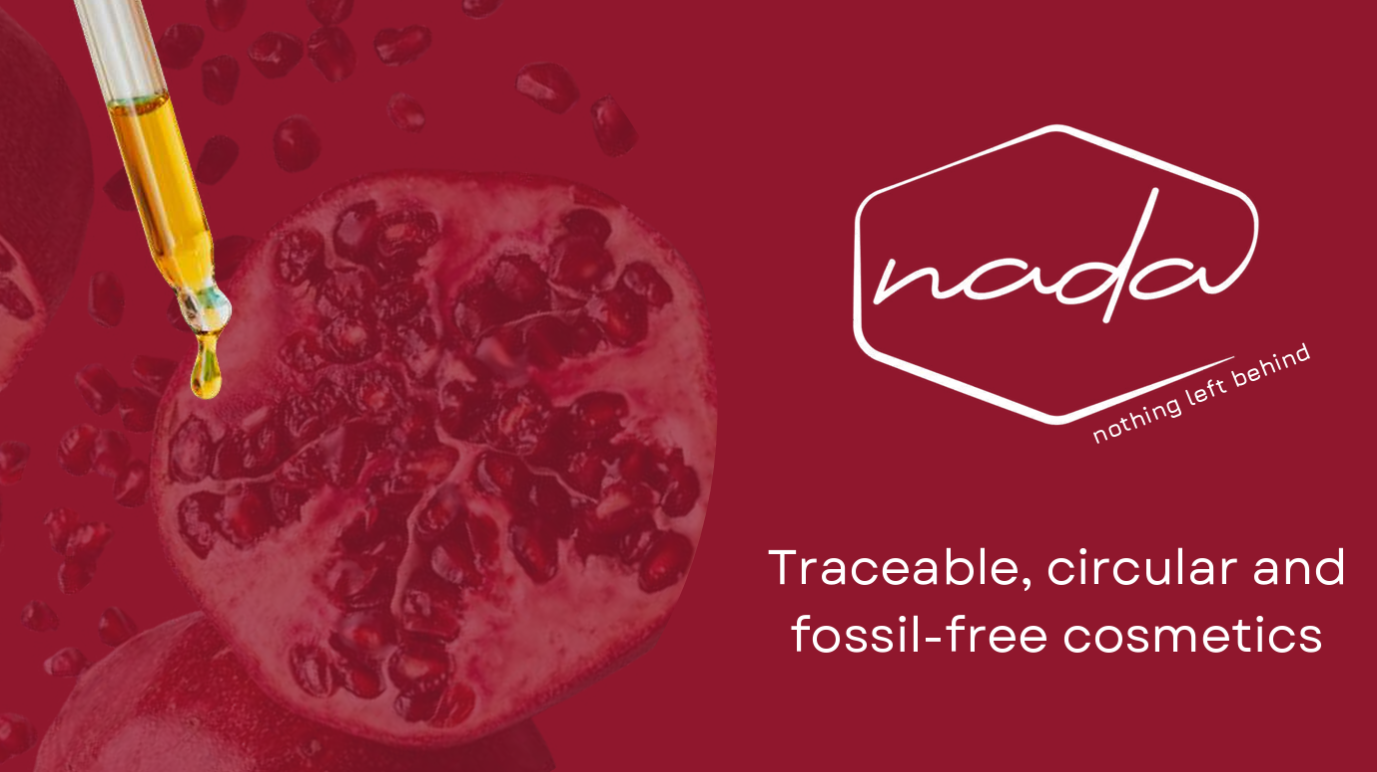
Its first product, POMega-5, is a pomegranate seed oil extracted from agricultural by-products. According to the company, laboratory samples have demonstrated approximately 25% higher antioxidant content than comparable commercial oils, making it suitable for applications including anti-ageing creams, hair care, acne treatment and sun-care products.
Yet during our conversation, it became clear that the oil itself is only part of the business.
The founders repeatedly returned to a problem that cosmetic companies face today: not finding natural ingredients, but finding suppliers they can rely on.
Many natural oils are sourced from fragmented farming communities across Latin America, Africa or Asia. Product quality often changes from one harvest to another, making it difficult for manufacturers to formulate consistent products.
Rather than competing purely on extraction technology, Nada is attempting to solve the supply chain.
The founders argue three things make the timing right. First, volume: by working with packing houses instead of individual farms, Nada accesses large streams of homogeneous waste in one location and have 1,000 tonnes of feedstock already secured over three years. Second, the technology is de-risked: supercritical CO₂ extraction already runs at industrial scale in other industries; Nada's patent covers the parameters that maximise yield per raw material. Third, demand is already there: pushed by the EU Green Deal and consumer pressure, brands are actively searching for replacements for petroleum-derived ingredients. Nada is fielding sample requests rather than pitching cold.
By securing rejected fruit at the source and controlling the supply chain from the beginning, Nada believes it can deliver greater consistency while also creating an additional income stream for farmers and agricultural processors.
It is a supply chain business disguised as an ingredient company.
Why the founders matter
One of the questions I asked during our interview was where Nada's real competitive advantage comes from.
Their answer was revealing.
Neither founder claimed that the technology alone would protect the business.
Instead, they argued that their advantage comes from combining expertise that rarely exists within the same founding team.
Francesco understands agriculture because he has spent years working inside it. He knows growers, exporters and processing companies across Peru, one of the world's largest fruit-exporting countries.
MJ understands cosmetics. She knows what ingredient buyers look for, how cosmetic companies validate suppliers and where demand is heading, particularly within the rapidly growing Korean beauty market.
Individually, these experiences would be valuable.
Together, they connect two industries that have historically operated independently.
An asset-light path to scale
Nada is still an early-stage company.
Rather than building an expensive extraction facility immediately, the founders are outsourcing production to existing industrial partners while they validate their first commercial products.
Their immediate objective is not revenue at all costs.
It is to prove that laboratory performance can be replicated at industrial scale, complete efficacy testing and place commercial samples into the hands of prospective customers.
The company is currently raising a €280,000 pre-seed round to achieve these milestones. According to the founders, the funding will support commercial sample production, efficacy testing and customer validation before raising a larger seed round. The broader financing strategy also includes leveraging public grants to extend its runway and accelerate product development.
More than a circular economy story
Many startups today describe themselves as circular economy businesses.
Nada's proposition feels slightly different.
The founders are not asking cosmetic companies to purchase ingredients simply because they are sustainable.
Their argument is economic.
Agricultural waste already contains valuable compounds. Cosmetic companies already need natural ingredients. Farmers already want additional revenue streams.
The missing piece is connecting these markets efficiently.
Whether Nada ultimately succeeds will depend on execution—proving product performance, scaling its supply chain and convincing large cosmetic manufacturers that it can deliver both quality and consistency.
But after speaking with the founders, one thing became clear.
Nada is not trying to convince the world that waste has value.
It is building a business around the belief that the value was there all along.
Summary:
Product
Turns agricultural waste into premium cosmetic ingredients, starting with pomegranate seed oil.
Industry
Climate tech × biotech for the cosmetic ingredient industry.
Team
Agtech founder from Peru paired with a Korean cosmetic R&D chemist.
Competitive Advantage
Unlike The Upcycled Beauty Company, No Palm Ingredients, Kaffe Bueno, and Lignopure, Nada combines scalable sourcing, traceability, and consistent quality.
Why Now
Demand for natural cosmetic ingredients is growing as brands seek sustainable alternatives.
Fundraising
Raising €280K pre-seed after securing €220K.
Use of Funds
Commercial samples, efficacy testing, and customer validation.
Milestones
Reach TRL 6, prepare 2 market ready ingredients, and secure 40 LOIs.