

If you think about Luxembourg only as a financial hub, you are missing one of Europe’s most interesting space stories.
Luxembourg entered the commercial space industry decades ago through SES, but its ambition has moved far beyond satellite communications. In 2017, Luxembourg became the first country in Europe, and the second globally, to create a legal framework for the exploration and use of space resources.
Today, the country has built a real space ecosystem around that ambition: satellite communications, Earth observation, space resources, lunar technology, remote sensing, in-orbit services, and space data infrastructure.
For a country of Luxembourg’s size, this is not a side project.
It is a strategic bet.
You can already see this through companies like SES, Hydrosat, Maana Electric, ispace EUROPE, and others building across satellite data, thermal imagery, lunar resources, and space infrastructure.
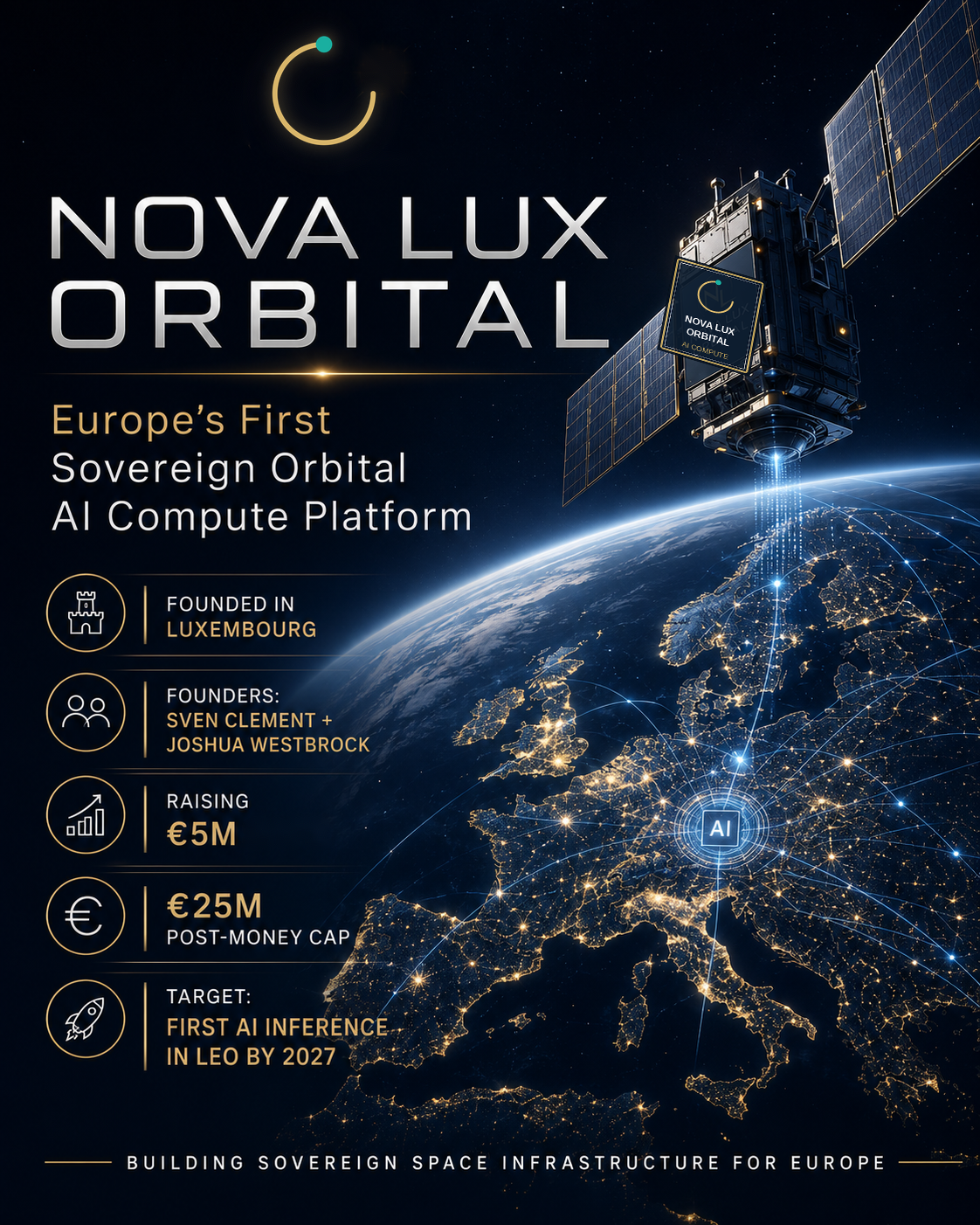
One company that recently caught my attention is Nova Lux Orbital.
I had the chance to speak with Sven Clement this week to understand why he wants to build Europe’s first sovereign orbital AI compute platform from Luxembourg.
The problem Nova Lux is solving is simple to understand, but extremely hard to execute.
Satellites generate huge amounts of data in orbit, but sending all of that raw data back to Earth is slow, expensive, and constrained by bandwidth. Today, most satellites still behave like “cameras with radios attached”: they collect data in space, then wait to send it back to Earth for processing.
Nova Lux wants to change that architecture.
Instead of sending raw imagery back to Earth, its satellites will process data directly in orbit using AI and send back intelligence: maritime tracking, change detection, defence alerts, ISR insights, and other mission-critical outputs.
In other words: satellites that do not just photograph.
Satellites that think.
What makes this especially interesting is the sovereignty angle.
As AI, defence, cloud infrastructure, and space converge, Europe cannot rely entirely on non-European infrastructure for critical intelligence workflows. This is not just a technical issue. It is a strategic one.
That is where Sven’s background becomes highly relevant.
Sven is not a typical space founder. He is a Member of the Luxembourg Parliament, a technology policy advocate, and a Special Rapporteur in the NATO Parliamentary Assembly’s Science and Technology Committee. He is also an entrepreneur behind digital ventures such as taxx.lu and salary.lu.
In our conversation, what stood out to me was how naturally he connects policy with product.
He has spent years working around technology, policy, AI, defence, and European sovereignty. Nova Lux feels like his attempt to move from discussing Europe’s dependence on foreign technology to actually building a piece of critical European infrastructure.
His co-founder, Joshua Westbrock, brings the technical depth. Joshua is a Principal Engineer on NASA’s Lunar Gateway HALO program at Northrop Grumman, with 15 years of aerospace engineering experience.
That combination is rare: institutional access and policy understanding from Sven, paired with deep aerospace execution from Joshua.
From an investor perspective, the company is interesting because Nova Lux is not trying to be just another component supplier in the space value chain.
The ambition is much bigger.
Nova Lux wants to operate the fleet, own the infrastructure, and sell processed intelligence to defence agencies, Earth observation operators, and European institutions.
Their first mission, Spark, is designed to validate AI inference in low Earth orbit. The company is currently raising a €5M at a €25M post-money cap to fund the build and launch of Spark, expand the engineering team, set up ground operations, and complete regulatory work.
The key milestone: launching the first AI-enabled satellite and achieving AI inference in orbit, targeted for 2027.
What I like most about Nova Lux is not only the technology.
It is the timing.
AI needs new infrastructure.
Defence needs faster intelligence.
Europe needs sovereignty.
And Luxembourg has spent years building the legal, institutional, and commercial foundation for space companies to emerge.
If Nova Lux succeeds, its first satellite will not just be a company milestone.
It could be another signal that Luxembourg’s space story is only beginning.
For investors looking at space, defence, AI infrastructure, or European technological sovereignty, Nova Lux Orbital is worth a closer look.