
Studios Keep the Image. Numonic Keeps the Recipe.
A visual effects studio once got an unusual demand from a film client: prove you never used a particular AI model, one now caught up in litigation. Without that proof, there was no job.
The story comes from Casey Milone, cofounder and CEO of Numonic. "If you don't have robust and really, really excellent record-keeping practices around this, there's no way for you to win that job with that studio," he said, "because you need to have an audit block of all of that work."
Most studios would fail that test. Per Milone, most aren't recording this information at all. Some keep a spreadsheet, which starts to "crumble under its own weight" once it passes a few thousand rows. Others hire someone whose whole job is tracking metadata by hand, a role that takes its institutional memory with it the day that person quits.
The recipe, not the picture
Milone is a copywriter by trade. He has worked as a creative director of copy, as editorial lead at Microsoft, and as a senior copywriter at NVIDIA, and he ran his own content agency for seven years. As generative AI moved into creative work, he noticed everyone focusing on the output: the finished image or video. The valuable part, he came to believe, was the recipe behind it.
"It's not just the generation that's valuable," he said. "It's actually the recipe that you use to make it that becomes very valuable in those contexts." The prompt, the model version, the seed, the LoRA. That is the information that lets a team reproduce a result, back up a claim, or hand a workflow to someone else. Save the file in an ordinary system and at best that metadata gets buried. At worst it's stripped out the moment the file is exported.
Milone and his cofounder, Jesse Blum, had been building small AI research projects together for some time before one of them became Numonic. They incorporated the company in the UK in June 2025.
Why it matters now
For a long time, lost metadata was a nuisance. Then regulators started paying attention to where AI content comes from. Since August 2, 2026, Article 50 of the EU AI Act has required companies that build generative AI tools to mark what those tools produce as AI-generated, and it requires anyone publishing realistic synthetic media to disclose it. California's AI Transparency Act, SB 942, took effect the same day with similar rules for the largest AI providers.
Neither law asks a studio to keep the recipe behind every image. But both make the origin of AI content a question clients are more likely to ask, and the film client in the opening story is an early example. A studio can only answer that question if it kept the record.
Much of Numonic's first year went into security, because of who the product is for. The studios Milone wanted to work with, teams with major film and streaming credits, weren't going to hand their intellectual property to a tool that hadn't been built with that risk in mind. "There was a lot of security build that needed to happen with this," he said, "because we're asking media companies to put intellectual property into it that would be incredibly dangerous for us from a liability perspective if there were any technical or security concerns."
The product
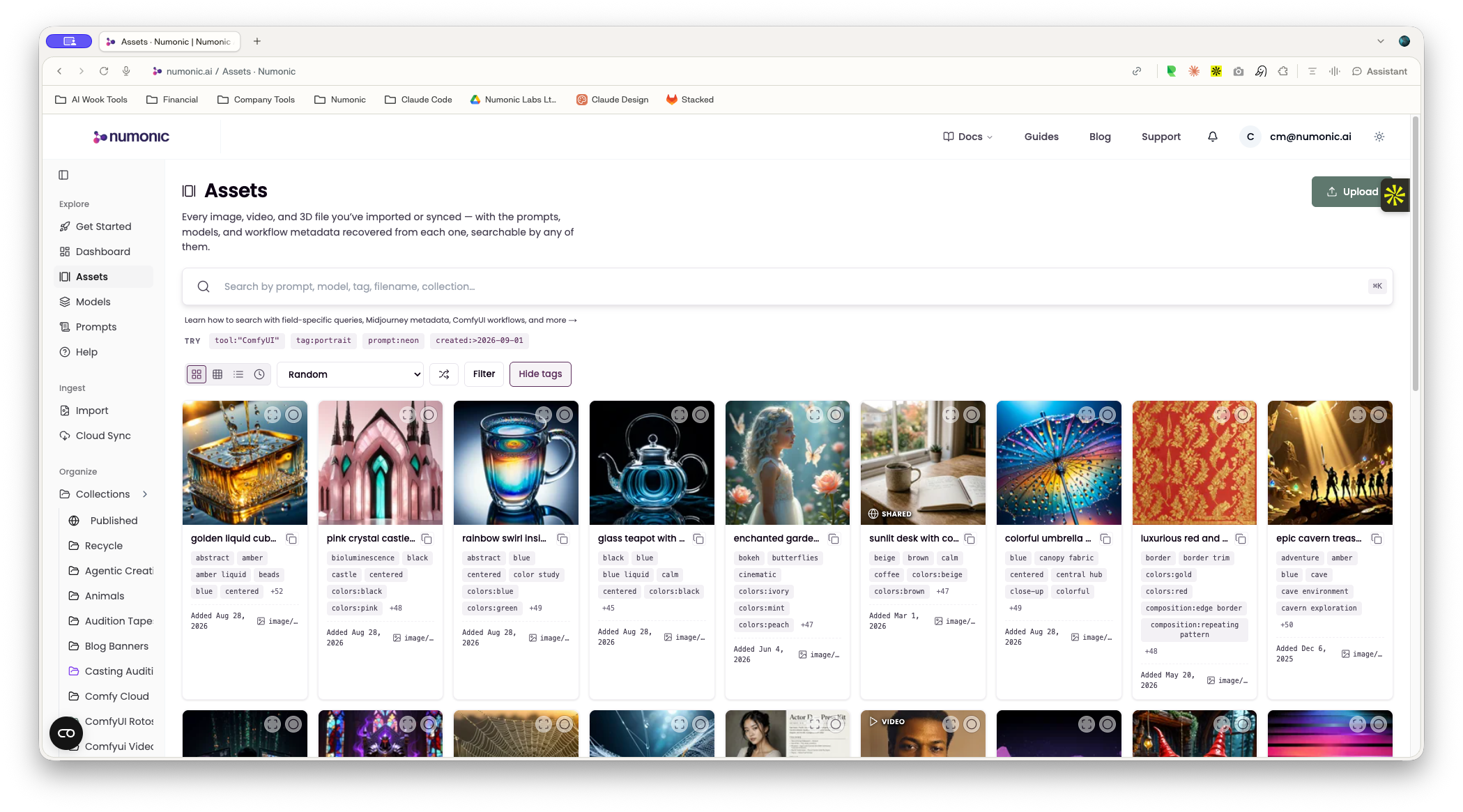
Numonic sits between a studio's generation tools, ComfyUI and Midjourney, and wherever finished work ends up, whether that's an existing DAM, a shared drive, or a client delivery. Every asset that passes through has its prompt, model, and parameters captured automatically. Semantic search makes a library findable by what's in an image, not just its filename. When work goes out the door, export presets decide what travels with it, so a studio can share an image without handing over the prompt and seed behind it. An MCP server lets AI agents search and file assets directly, without touching the interface.
There's a free tier, and paid plans start at $23 a month.
The team looked at building on existing data platforms, Snowflake among them, and decided against it. Instead, Blum designed a data model built for lineage. Every node in a ComfyUI workflow and every Midjourney variation is stored as a linked record that is added to, never overwritten, so an asset's history can be traced step by step. Milone sees that record, not the interface, as the part that is hard to copy.
The company describes its roadmap in three stages. Capturing provenance is what exists today. Next is automation, with agents that apply a studio's provenance rules without manual review. The long-term aim is a system of record for AI creation that other tools write to and query. In that picture, Milone says, the library studios use today is the first application built on the record, not the end state.
Where the demand is coming from
Numonic is focused on four verticals: marketing and advertising, video games, e-commerce, and film and television. The target customer is a studio of 10 to 300-plus people producing more than 500 AI assets a month. Milone is candid about how those verticals were chosen. "Follow the money," he said. "That's always the way it is in the early days."
Early interest has come from further afield than a typical startup story, with some of the strongest pull from South Asia, South Korea, and, unexpectedly, Italy's AI marketing agency scene. Numonic's first design partners are film and television studios.
Who's building it
Numonic has two founders. Milone runs strategy, marketing, and fundraising as CEO. Blum, the CTO, holds a PhD in computer science and architected the data infrastructure behind Numonic's lineage records. The company is a four-person team, incorporated in the UK and backed by UK venture firm Fuel Ventures and a US angel investor.
The images will keep getting easier to make. Numonic is betting that the record of how they were made is what studios will need to keep.