

The $75 Billion Problem Hiding in Plain Sight - Behind Every Factory Wall
Walk past any refinery, gas pipeline, or data center and you'll feel it before you see it: heat, radiating off the equipment. To date only a fraction of it is being recovered.
That's not a side effect. That's the business model of modern industry - burn energy, use a fraction of it, vent the rest.
67%+ of applied energy in industrial and power processes is lost as heat. The wasted industrial heat in the U.S. alone is 5x the total electricity the country produces. PwrCor calls it the world's largest overlooked energy resource - and until now, almost nobody could touch it.
PwrCor Technology Solutions thinks they can.
PwrCor at a Glance
Company: PwrCor Technology Solutions
What it does: Converts low-grade industrial waste heat (140°F–570°F / 60°C–300°C) directly into on-site electricity using a proprietary supercritical CO2 (sCO2) Brayton Cycle engine
Technology stage: Generation 4; developed over 5 years in partnership with the Southwest Research Institute (SwRI)
Field validation: Generation 1 piloted and validated by the California Energy Commission in a geothermal application
Commercial traction: $150M+ in conditional letters of intent from two Oil & Gas majors, pending field pilots
Performance: Up to 3x more power than legacy ORC systems, from the same heat source
Economics: $0.09/kWh levelized cost of energy; ~3-year capital payback for the buyer / user of PwrCor Technology
Reliability: 24/7 on-site baseload power, no grid dependence, no energy storage required
Safety/environmental: Zero hazardous fluids (sCO2, not refrigerants), zero emissions, actually negative carbon.
Integration: External skid architecture - no redesign of client's existing compressor equipment
IP: Patent-protected; held within PwrCor's own group
Market: $75.3B TAM / $51.9B SAM / $8.9B SOM / $3.9B U.S. Gas Compression beachhead (~16,800 deployable units globally)
Business model: Direct machine sales + installation + maintenance, with rental and direct-exploitation models also under consideration
Team: 5 leaders with 100+ combined years across global energy, oil & gas, cleantech, enterprise sales and B2B marketing
Accelerator: Admitted into the Harvard iLabs Climate and Environment Accelerator
The raise: $10M - $5.5M pilot execution, $2.5M R&D/IP, $2M business development
Contact: JC Vautrin, CEO - jc.vautrin@pwrcorts.com
Leadership Team: Operators and Builders
PwrCor’s leadership combines deep energy and technology expertise with proven revenue, marketing, and business-building experience. JC Vautrin brings 30+ years in global energy, oil & gas, industrial innovation, and sustainability leadership. Thomas Telegades brings 20+ years in advanced energy systems, engineering, technology development, and commercialization.
Larry Posner, Sherri Sklar, and Dessy Vautrin bring complementary expertise across technology commercialization, enterprise sales, revenue growth, GTM, marketing, and capital formation. The team includes three Harvard Business School MBAs, alongside INSEAD and engineering credentials, with decades of experience building and scaling businesses.
The technology: heat that current systems simply can't touch
The existing tool for waste-heat recovery - the Organic Rankine Cycle (ORC) - was invented roughly 80 years ago. It's effective, but only at high temperatures: think 500°C oil refineries or 1,200°C steel smelters. Below that, most heat is simply lost. It isn't stored - heat that isn't converted the moment it's produced is gone.
PwrCor's engine is built around a different physics: a proprietary supercritical CO2 (sCO2) Brayton Cycle, engineered to extract power from low-and-medium-temperature heat - specifically the 140°F–570°F (60°C–300°C) band that legacy ORC systems can’t capture efficiently
What that means in practice, per PwrCor's own figures:
Up to 3x more power output from the same heat source compared to legacy ORC systems
24/7 baseload electricity, generated on-site, with no reliance on batteries or grid transmission
Zero hazardous fluids (sCO2, not refrigerants) and zero emissions
An external skid architecture - the unit bolts onto existing compressor infrastructure without requiring any redesign of the client's equipment
A projected $0.09/kWh levelized cost of energy, with a typical 3-year capital payback
In the founder's own explanation on a recent call: the machine sits beside a client's gas compressor or other industrial heat generators, captures the heat that compression generates, converts it directly into electricity, and feeds that power straight back into the compressor's own system - reducing how much power that compressor needs to pull from the grid. JC put a rough number on it: depending on the use case, the energy savings can go up to 10%. No transmission lines. No infrastructure buildout. The savings and the decarbonization happen in the same box.
Who owns what
This is a detail investors always ask about, so it's worth stating plainly: the core IP and patents sit inside PwrCor's own group. Southwest Research Institute, the global leader in advanced energy systems and supercritical CO₂ (sCO₂) power-cycle technology, built and tested the machines in partnership with PwrCor.Proof, not just a pitch
PwrCor isn't asking investors to believe in a whiteboard. The technology has already been field-tested once, publicly: a Generation 1 version of the engine was piloted and validated by the California Energy Commission in a geothermal application. The current version in development is Generation 4 - a meaningfully more effective iteration of that same proven core.
On the commercial side, PwrCor has signed conditional letters of intent with two Oil & Gas majors, representing $150M+ in potential orders - contingent on successful field pilots of purpose-built machines at their facilities.
Here's the timeline math behind that milestone, per JC: roughly 90% of the underlying technology is common across every application. The remaining 10% is use-case-specific adaptation - building a full-scale first unit for a given vertical, installing it, and testing/measuring it in the field. That adaptation-to-proof process runs one year to 18 months per vertical. This funding round is earmarked to run that process for two specific verticals: CO2/CCUS (Carbon Capture, Use and Storage) and gas pipeline transportation compression - the two verticals tied to the existing $150M in conditional orders.
The market
PwrCor frames its opportunity as the "bottom of the heat pyramid" - the low-grade heat band that's too cold for legacy recovery technology to touch, but represents the largest share of wasted industrial energy by volume. Their own market sizing:
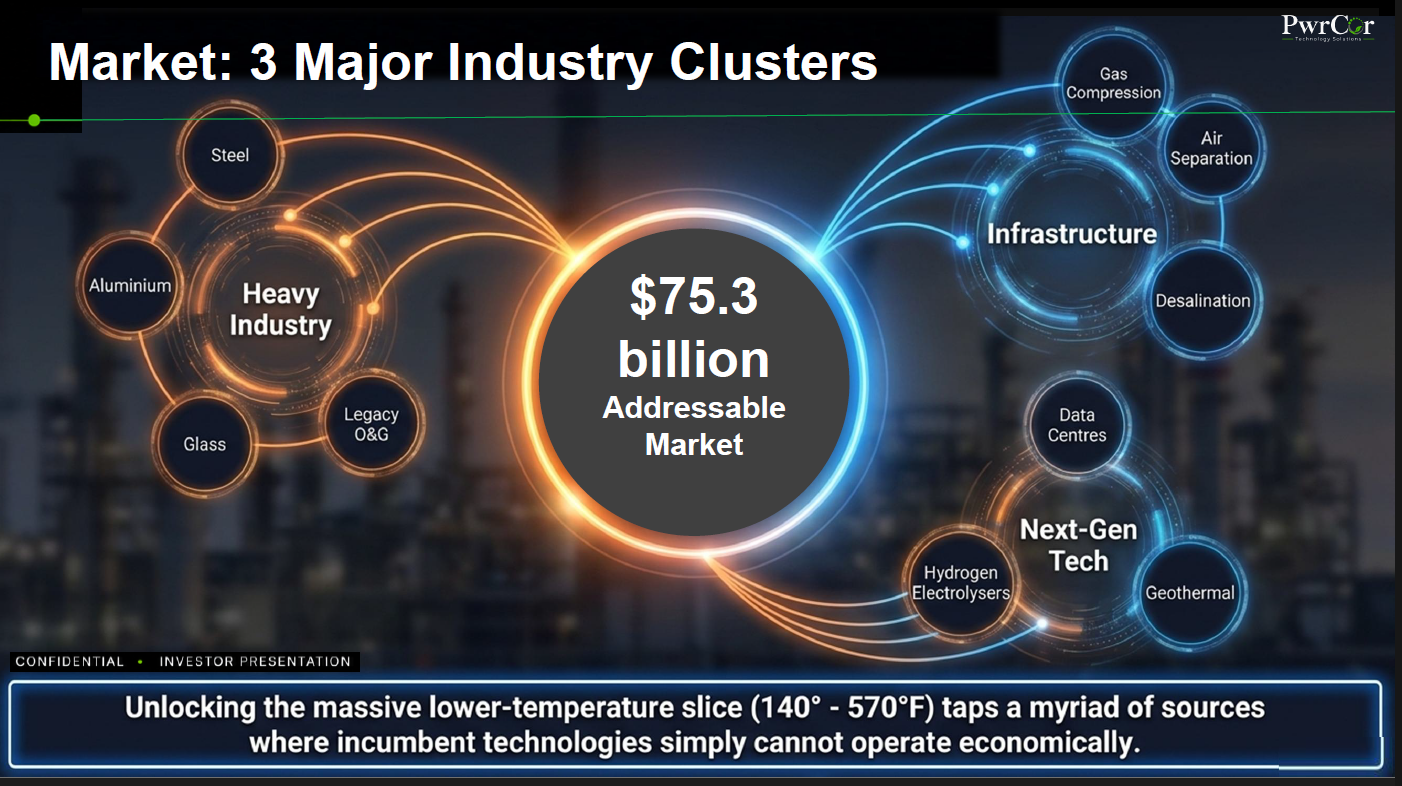
$75.3B total addressable market (global industrial waste-heat recovery)
$51.9B serviceable addressable market (segments matching the 70–200°C operating window)
$8.9B serviceable obtainable market (~16,800 deployable engine units globally)
$3.9B U.S. Gas Compression SOM - their immediate, first-market beachhead
Three industry clusters make up that TAM: Heavy Industry (steel, aluminium, glass, legacy oil & gas), Infrastructure (gas compression, air separation, desalination), and Next-Gen Tech (data centers, hydrogen electrolysers, geothermal).
The business model
The core model is B2B: PwrCor sells the machines directly to industrial clients, bundled with installation and ongoing maintenance. But on the same call, JC was clear that isn't the only path they're considering - he pointed to renting out the machines, or directly exploiting assets themselves (he cited geothermal fields as an example use case), as business models they're actively thinking through alongside a straight sale.
Because these are long-lived industrial assets, the relationship doesn't end at the transaction either way: continuous R&D partnership and iterative generations (the same pattern that took the technology from Gen 1 to Gen 4) keep PwrCor engaged with clients over years. Manufacturing itself will be subcontracted rather than built in-house - a deliberate capital-light choice reflected in the "4-pillar" go-to-market plan: beachhead market → execution with a Fortune 200 pilot partner → expansion to adjacent verticals → OEM partnerships for distribution.
The team
JC Vautrin, CEO - 30+ years in global energy, oil & gas and industrial innovation; former executive at Total, Elf and Plama Lubricants; named Sustainability Leader of the Year, 2025; MBA, INSEAD
Thomas Telegades, CTO - 20+ years in advanced energy systems and technology commercialization; MBA, Fairleigh Dickinson University
Larry Posner, Executive Chairman - 30+ years in technology commercialization, private equity operations and business transformation across cleantech, SaaS, manufacturing and industrial sectors; former Managing Director at Alvarez & Marsal, Co-Founder of AI Venture Catalyst; MBA, Harvard Business School
Sherri Sklar, Chief Sales Officer - 25+ years in enterprise sales and revenue growth across AI Venture Catalyst, BeamSec and private-equity backed SaaS companies; MBA, Harvard Business School
Dessy Vautrin, Chief Marketing Officer - 25+ years in B2B marketing, demand generation and capital raising, across Alcoa, Temper Systems and Blue Orb; MBA, Harvard Business School
The raise
PwrCor is seeking $10M over 30 months to fund the next set of commercialization proof points:
$5.5M - fully fund and execute the two Fortune 200 pilot projects, the trigger for the $150M pipeline
$2.5M - R&D and IP, advancing the core technology and expanding the patent moat
$2M - business development, scaling licensing efforts and securing additional OEM partnerships
What kind of investor they're looking for
This is where PwrCor's founders were unusually candid. - they favor a partner willing to stay engaged for mid to long term, ideally with industry contacts or end-user experience,. J
The future: PwrCor’s two Fortune 200 pilots are the next step toward converting $150M in conditional orders into commercial revenue, building on the successful California Energy Commission geothermal pilot. The opportunity sits within an estimated $75.3B market, addressing a temperature range that no other technology can currently serve.
Contact: JC Vautrin, CEO - jc.vautrin@pwrcorts.com | +