

The Bugs That Eat Plastic: Inside Hexa's Bet on Turning Trash into Protein
Every year, the world produces more plastic than the year before. By 2050, annual global output is projected to hit a billion tons; by 2100, more than 1.5 billion. Most of it will not be recycled — it will sit in landfills, wash into oceans, or get burned. This is not a problem that fixes itself. It compounds.
In the Yucatán Peninsula, near Cancún, four founders think they've found a crack in that problem worth exploiting — and it starts with an insect that eats plastic for lunch.
An organic origin story
Hexa didn't start as a business plan. It started with a biologist named Isaac de la Rosa, who spent years studying insects as a potential human food source. Along the way, he came across research suggesting that certain insects could, in theory, be trained to consume plastic at scale. He tested it in his own small-scale production alongside Liliana García, who provided deep expertise on feed safety, formulation, and regulatory permissions. It worked. They scaled it further. It kept working.
Isaac and Liliana then connected with Hugo Montalban, who they’d worked with previously, who brought the commercial and business vision, and Luis Gerardo Carvajal rounded out the founding team on the financial, sustainability, and automation lens the venture needed. Today Isaac serves as CEO running operations and pitching investors, Luis leads finance and automation of the insect-production process, Hugo drives sales and pipeline, and Liliana manages client-specific formulas and food-safety compliance. The company currently has one additional employee running the production line, with a first sales hire targeted for the following spring.
The company itself has existed in some form for four years, but restructured into its current entity, Hexa, about a year ago — around the same time its Mexican patent on the insect biotransforming process for expanded polystyrene (styrofoam) was granted, this past May.
What Hexa actually does
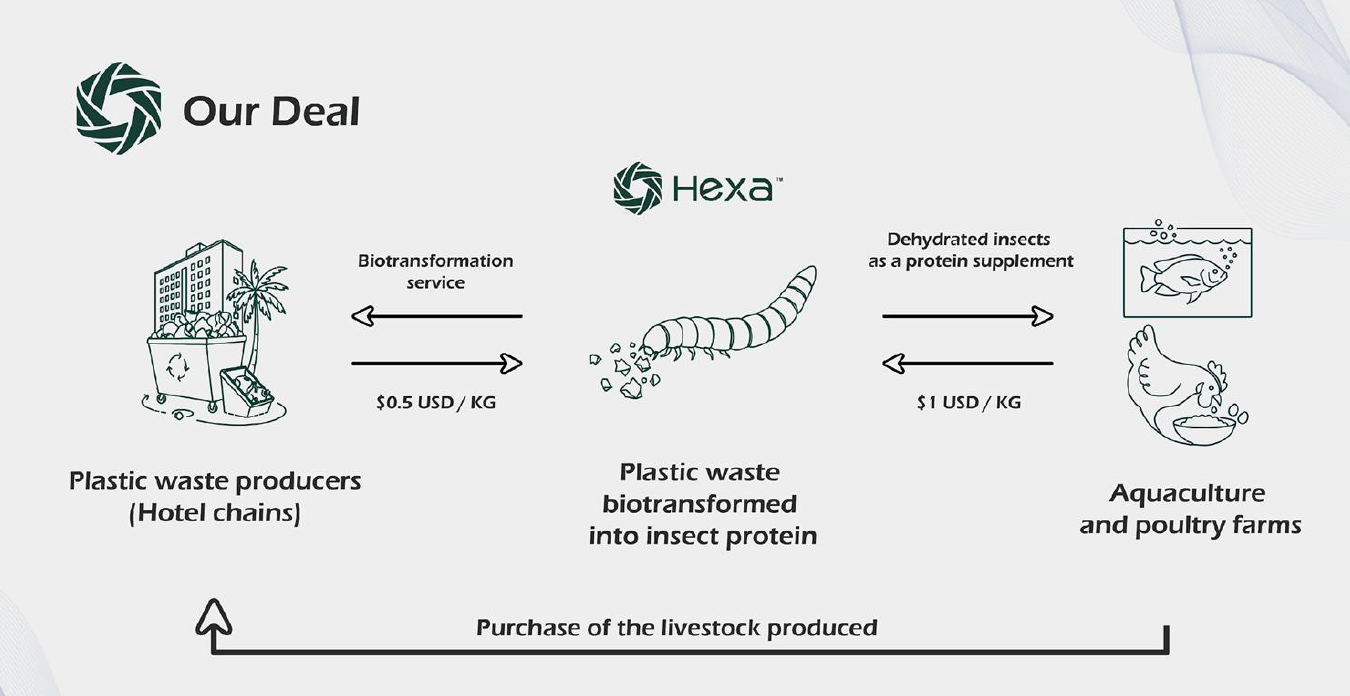
Hexa's process runs in two stages. First, plastic waste — starting with styrofoam, sourced largely from hotel chains in Playa del Carmen, one of the regions in Mexico with the weakest solid-waste infrastructure — is processed into feed for specialized insects, which biotransform it through their gut microbiome, converting this critical waste stream into high-nutrition insect biomass. The insects themselves are the constant raw material across every version of Hexa's product. What changes downstream is the formulation: dehydrated insect protein is blended with different vitamin profiles and ingredients depending on the ideal diet of the end animal, in a format resembling a compressed pellet, not unlike commercial pet food.
Whatever the insects don't fully convert doesn't go to waste either. The remaining biomass, including insect excreta (called “frass”) that could still carry microplastic residue, is run through pyrolysis and converted into biochar — a soil additive — so no plastic re-enters the environment at any stage.
Today, Hexa runs the entire chain itself — collection, biotransformation, formulation, and final product. Longer term, the plan is to license the technology so other operators can run the final-product stage themselves, while Hexa focuses on the biotransformation core and its IP.
Why a zoo cares
Hexa's first paying customers weren't farms — they were conservation facilities. Its first customer was a zoo feeding the product to its parrots. That is deliberate: Hexa currently holds formulas for exotic birds (including tropical species like macaws), and is developing formulas for flamingos, monkeys, and fish. Endangered and exotic species come with smaller volumes but far higher margins, which is exactly the segment Hexa is targeting first, before pursuing higher-volume, lower-margin markets like farmed salmon and tilapia later.
The company frames its edge around three things. It says it's up to 50% cheaper than the competition, which mostly consists of products that need to be imported from the US versus Hexa's local delivery. And it argues its protein is more biologically appropriate: wild animals naturally eat insects in their diet, but most commercial feed products for them don't contain any.
Independent customer research backs some of this up. Across 63 interviews with small and medium producers, 78% asked to start using the supplement after seeing it, and all of the product samples offered during site visits were consumed by the animals. The same research flagged what still needs solving: producers want laboratory validation, they see the roughly 50% lower price point as compelling, and they'd prefer home delivery as the primary sales channel.
Early traction, real constraints
Hexa says it has five sizable customers in its pipeline, each representing $3,000–$5,000 in monthly revenue at scale. Three customers are currently in a testing phase — starting with a small group of animals (around 15) before expanding to their full population (up to 400) if results hold. So far, the company says results have been positive, and one customer moved from trial to purchase in two days; the more typical sales cycle runs two to four months.
Revenue today is small — the company describes it as early and is still validating at low volume. A single production unit, built for roughly $60,000–$70,000 in CAPEX, can produce about two tons of product a month, generating an estimated $7,000–$16,000 in monthly revenue at a reported ~65-70% gross margin, with payback on that unit in around 11 months at full throughput. Because the process is modular, the production volume scales close to linearly.
To date, funding has come almost entirely from non-dilutive sources: around $5,000 of the founders' own capital, a Santander X Award grant (issued in Spain, routed to the Mexican entity), several additional Latin American grants, and a production-space partnership with one client, provided in exchange for a future supply arrangement. The company has also since been recognized among roughly 500 competing projects at the NTT DATA eAwards and been accepted into a StartUp México accelerator program — signals that have added some outside validation to the pitch. Isaac, CEO of Hexa, was recently featured in Forbes 30 under 30 Mexico 2026.
The raise, and what it buys
Hexa is currently raising $250,000. Without the capital, the company believes it can still operate and reach its current scale-up target organically — just over three to four years. With the capital, it says the same milestone — moving from roughly 2 tons to 20–25 tons of monthly production — could be reached in eight to nine months, alongside R&D on new species formulas, including one for salmon, a market the team specifically flagged as attractive given how expensive existing salmon feed is today.
Geographically, the plan for the next phase of sales stays close to home: expansion out from the Yucatán Peninsula into central Mexico, then into Central America — Ecuador, Panama, Costa Rica, and Guatemala are the markets named. Filings in the US and Europe are in the works too, but the team is explicit that this is largely a defensive IP move — patents must be filed internationally within a year of the original filing to stay protected — rather than a near-term go-to-market push into those regions. The company is incorporated solely in Mexico for now; opening additional entities elsewhere is on hold given the administrative cost.
Looking further out, Hexa's own five-year plan sketches a path from an industrial pilot plant (2026) toward franchise and planning of an innovation center called "Hexa Hub" (2027), international commercialization through licensing and a dedicated solution-development lab (2028), a hub-solution launch alongside new patent filings (2029), and global commercialization of its broader biotech platform by 2030. The company's stated five-year targets: improving conditions for at least 45% of small and medium fish-stock producers in Mexico, bioconverting more than 500 tons of plastic waste, scaling through technology licensing, and developing at least three additional high-impact patents. The company has also described ambitions to eventually become a broader "Hexa Group," extending the same bioconversion platform into other biotech-adjacent categories.
What the founders worry about
Asked directly about risk, Luis Gerardo didn't point to competition or demand. He pointed to cash flow and speed — the challenge of funding scale-up fast enough to hit the growth trajectory the team believes the market will reward, rather than any doubt about whether customers exist. Customer acquisition, he said, is something the team feels it has handled well so far; the bigger risk is simply being too slow relative to the opportunity in front of them.
The bigger picture
Hexa's addressable market, by its own sizing, sits inside a global protein-supplement category worth an estimated $22.5 billion as of 2023, growing at roughly 17% annually, with a $632 million national opportunity in Mexico and an initial beachhead of about $38 million. The company estimates its process generates 3.2 kg of CO2-equivalent per kilogram of protein, versus 8.4 kg for conventional fish meal — a 62% reduction — and claims 84,000 kg of CO2e avoided and 46,000 kg removed as biochar over two years of operation, alongside up to 22% productivity gains and up to 40% higher protein quality for the animals fed on it.
None of that guarantees Hexa wins. It's a small team, four years into a technology bet, still validating unit economics one testing cycle at a time. But it's also a rare case where the environmental story and the commercial story aren't in tension — the same insects that make Hexa's product cheaper and more available locally are the ones quietly processing plastic that would otherwise never break down. For investors looking at the intersection of climate tech and agriculture, that combination — real patented IP, early paying customers, and a founding team that already knows exactly what its biggest risk is — is worth a closer look.
Sources: interview with Hexa co-founder Luis Gerardo Carvajal Fernández (September 2026); Hexa investor pitch deck (September 2026); "HEXA: Turning Plastic Waste into Value," AIM2Flourish.
Hexa — At a Glance
What it is: A Mexican biotech startup that feeds insects plastic waste and turns the byproducts into protein-rich animal feed and fertilizer.
Founded: Company has existed 4 years; restructured into its current entity (Hexa) about a year ago.
Patent: Granted in Mexico this past May; international filings (US, Europe) planned within the patent's priority year, mainly for IP protection.
Founders: Isaac de la Rosa (CEO, biotechnology), Luis Gerardo Carvajal (finance/automation, sustainability), Hugo Montalban (commercial/sales), Liliana García (feed safety/formulas/permits).
Team size: 4 founders + 1 production employee; a salesperson hire planned for next spring.
The tech: Insects biotransform plastic waste (sourced from hotels) into dehydrated animal feed pellets; leftover biomass is pyrolyzed into microplastic-free biochar fertilizer.
Revenue model: Collection fee for waste plastic; B2B sales of protein-rich animal feed and biochar.
Current structure: Vertically integrated (does everything in-house); plans to license the tech to other producers in the future.
First customers: Conservation facilities — its first client was a zoo, feeding parrots.
Species covered: Birds today; developing formulas for flamingos, monkeys, and fish, with salmon and tilapia as future high-volume targets.
Differentiators: Up to ~50% cheaper than the market leader, local delivery vs. imports, and a more "natural" insect-based diet.
Customer research: 63 interviews conducted; 78% asked to start using the product after seeing it; 100% of live samples were consumed by animals.
Pipeline: 5 major customers lined up, each worth $3,000–$5,000/month; 3 are in active testing (scaling from 15 to up to 400 animals).
Sales cycle: Typically 2–4 months; fastest deal closed in 2 weeks.
Unit economics: ~$60–70K in capex builds a 2-ton/month plant; ~65-70% gross margin; ~11-month payback at current scale.
Funding to date: ~$5,000 of founders' own money, plus grants (Santander X Award, other Latin America grants) and a free production-space partnership from a client.
Current raise: $250,000 to scale from 2 tons/month to roughly 20–25 tons/month and fund R&D on new species formulas.
Raise impact: Could compress a 3–4 year organic scale-up into 8–9 months.
Expansion plan: From the Yucatán Peninsula into central Mexico, then Central America (Ecuador, Panama, Costa Rica, Guatemala).
Incorporation: Mexico only for now, due to the administrative cost of opening entities elsewhere.
Biggest self-identified risk: Cash flow and speed of scaling — not customer demand.
Market size: $22.5B global TAM (2023), 17% CAGR, $632M national SAM, $38M beachhead.
Climate impact claimed: 62% lower emissions than fish meal (3.2 vs. 8.4 kg CO2e/kg); 84,000 kg CO2e avoided and 46,000 kg removed as biochar over 2 years.
Product impact claimed: Up to 65% more affordable, 22% higher productivity, 40% higher protein quality.
Recognition: Recognized among ~500 competing projects at the NTT DATA eAwards; accepted into a StartUp México accelerator; CEO recognized in Forbes 30 under 30 2026.
5-year vision: Improve conditions for 45%+ of Mexico's small/medium fish-stock producers, bioconvert 500+ tons of plastic, license the tech globally, and file 3+ new patents.